Sonata Op.13 (1984) for viola and piano c. 28'00"
I. Allegro moderato
II. Andante
III. Recitativo; Allegro feroce
First performed on April 29th, 1985 at Town Hall in New York City by Neal Gripp, viola and Daniel Lessner, piano
Dedicated to Neal Gripp
First Prize, Victor Herbert/ASCAP Awards, National Federation of Music Clubs 1986
ABOUT
Organic unity in terms of structure and thematic material is a prime factor in this work. The Sonata centers around G-sharp major/minor; the inherent half-step conflict is of prime importance to the tonal and thematic development. The first movement has an arc-like structure. The opening theme in the viola is actually first heard in augmentation, with the piano measures half as long as the viola measures. This polymetric device is further exploited in the movement's central development section and coda, where the viola and piano parts end "out of phase" by half a measure until the final chord.
The second movement is a series of continuous passacaglia variations on a theme derived from a 17-note figure heard in the first movement. The passacaglia theme is heard at the beginning of the second movement in the piano alone. Each of the successive 17 variations is transposed to a successive note of the theme itself, so the entire movement becomes, in effect, a single large variation. Since the variations are continuous and the theme not always the most prominent material, another form emerges, whose thematic structure is related to the phraseology of the theme (again enhancing the idea of the whole movement as being a single large variation.)
The third movement begins with a short recitativo section alternating viola and piano, which leads directly into the body of the movement, marked Allegro feroce. Here, in a rondo-like structure, previous material from the other movements is further developed and summarized.
The opening four chromatically descending chords of Gesualdo's madrigal "Moro lasso" occur at several strategic points in the first movement and in the coda of the last movement. These "quotations" have no ulterior programmatic significance, but are consistent (and at the time of composition, seemingly inevitable) with the work's motivic development.
RECORDINGS
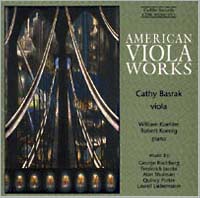
REVIEWS
“Lowell Liebermann, a 23-year-old composer from New York City…is, on the strength of this piece alone, a musician and composer of significance…What is astonishing about the piece is not so much the skill with which it has been organized, which is impressive, but the incredible range of emotion it covers. This is music that has something to say - it is not something that has been manufactured for an occasion. The word ‘genius’ is overly exploited these days, but to find someone that young who can so masterfully express warmth, passion, tenderness, anxiety and loneliness without self-consciousness, without over-stating and sentimentalizing, and with a simplicity of means that is deceptive, brings the term immediately to mind.”
The Ottowa Citizen
“Lowell Liebermann’s Sonata for Viola and Piano is a major composition rich in musical content and extremely rewarding for its performers. This work is recommended very highly to all violists…”
Violexchange
“The disc’s finest 25 minutes belong to its last track: living tonalist Lowell Liebermann’s SOnata for Viola and Piano, athree-movement work graced with the prized New Yorker’s distinct talent for finding in the language of the Romantics a new, more urgent musical way to express obsession…a truly gritty rant.”
culturebox
“Liebermann’s Sonata is an attention grabber.”
Fanfare
“From a programme of amiably unexceptional Americana, there leapt (almost literally) a Viola Sonata by the young American composer Lowell Liebermann, striking for its muscle, character and unexpected Russophilia.”
The Independant on Sunday (UK)
“…it is fresh, dramatic, and sometimes haunting music. Mr. Liebermann knows how to use repetition, how to vary a moto perpetuo, how to brood or ruminate without losing the listener’s attention.”
The New York Times